

Summary
Electricity moves through five main stages — from power generation to billing, with clear roles for procurement, transmission, distribution, and retail.
TNB sits at the heart of Malaysia’s electricity system, owning the National Grid and acting as the key player across most of the power supply chain.
While Malaysia still depends heavily on coal and gas, the government is pushing toward renewables, targeting 70% clean energy by 2050.
Disclaimer: Word of Caution!
Please DO NOT take this educational post as a buy or sell signal. When it comes to investing, it is important to have your own judgement. Despite my detailed analysis, mistakes may occur, and blindly following could lead you to make similar errors and financial losses. Furthermore, I AM NOT a licensed financial advisor. I’m merely sharing my experiences and opinions only.
Additionally, please note that I hold positions in the discussed stock, and my view may be biased as a result.
How is Electricity Generated?
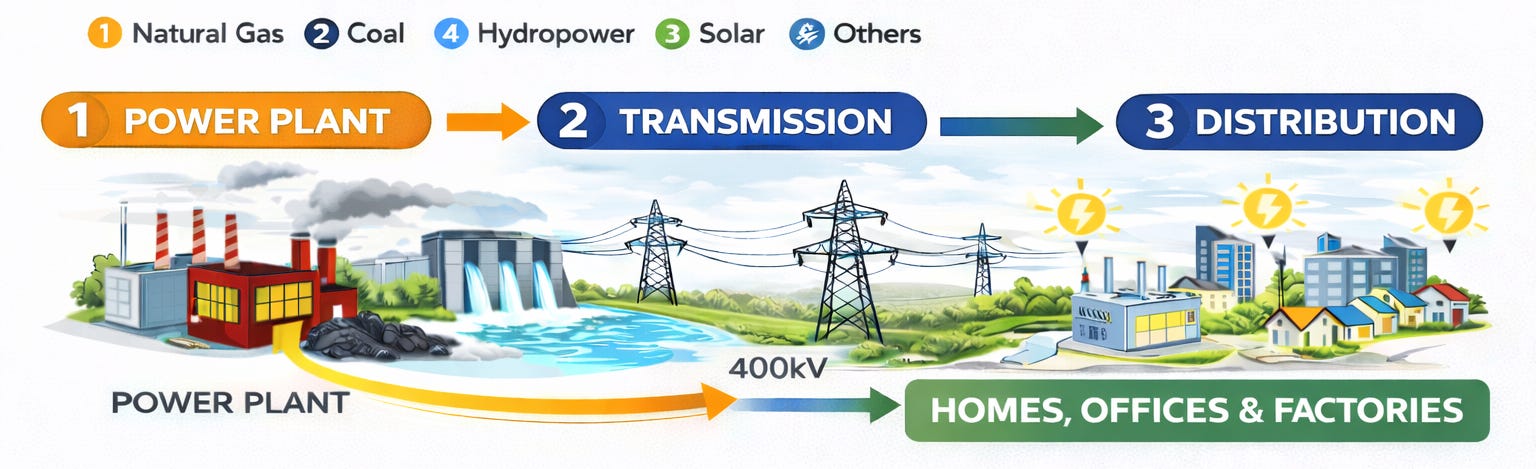
Electricity is generated by converting energy sources into electrical power. Gas and coal plants use steam to spin turbines, hydropower relies on flowing water, and solar farms generate electricity through photovoltaic panels.
Once generated, electricity is stepped up to high voltage for efficient long-distance transmission through the power grid. It is then stepped down at substations and distributed safely to homes, offices, factories, and other end users.
Malaysia uses combination of energy sources:
Non-renewable source: coal, natural gas, oil & diesel
Renewable energy source: hydro, solar, wind & biomass
Below is the weightage of each energy sources used by TNB to generate electricity as of 3Q25:
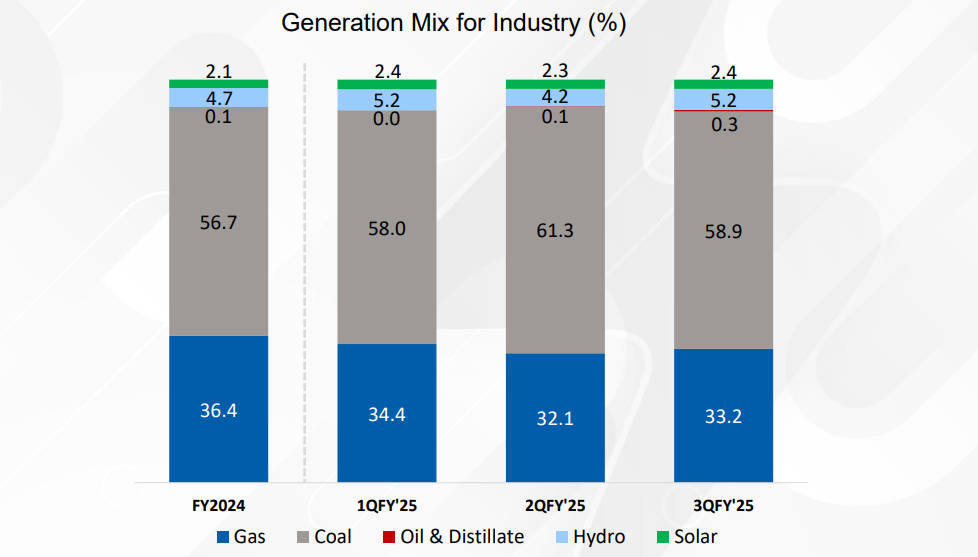
We are still relying heavily on non-renewable energy sources (92.4%) for Peninsular Malaysia. In 2023, Malaysia government launched the National Energy Transition Roadmap (NETR) as a strategic plan to move towards the use of cleaner and more sustainable energy source. The plan highlights some key targets such as the gradual increase usage of renewable energy: 31% by 2025, 40% by 2035 and 70% by 2050.
Energy Landscape in Malaysia
Overview
The power sector in Malaysia is controlled by 3 companies:
Tenaga National Berhad (TNB) – covers Peninsular Malaysia
Sabah Electricity Sdn Bhd – covers Sabah and Labuan
Syarikat SESCO Berhad (or better known as “Sarawak Energy”) – covers Sarawak
The first two entities are regulated by the Energy Commission (Suruhanjaya Tenaga) and Energy Commission of Sabah (ECoS), respectively. While Sarawak Energy operates independently under the Sarawak state government’s jurisdiction.
Notably, TNB holds an 83% stake in Sabah Electricity, making it the dominant player in Malaysia’s power sector with Sarawak being the only exception.
Both EC and ECoS are government regulators that oversees:
How much utilities company can invest into building power infrastructure
How electricity prices should be calculated
Ensures utilities company earn a fair but controlled return
Protect consumer from sudden price shocks
Since this research is about TNB, I will focus on where TNB has exposure which is mainly Peninsular Malaysia, Sabah and Labuan.
Supply Chain Structure in Peninsular Malaysia
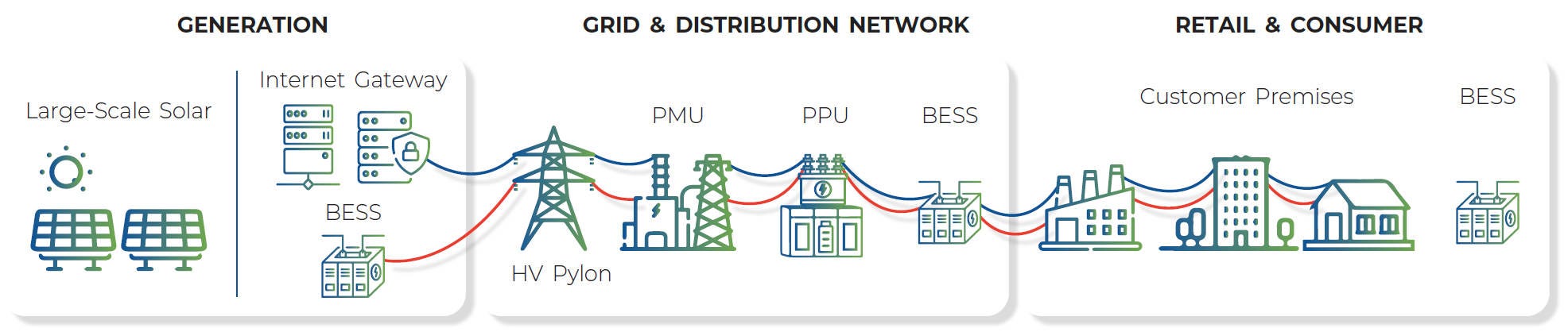
The supply chain of electricity in Malaysia can be broken down into 5 primary segments:
Generation
Procurement & Grid Management
Transmission
Distribution
Retail
Below are a detailed insights into each segment of the supply chain:
#1: Generation
This segment is where power is produced through various power plants. In Malaysia, most of the electricity are produced by TNB Power Generation (TNB Genco) and various Independent Power Producers (IPPs) such as Malakoff, YTL Power, etc. It is a competitive segment because TNB has to compete with other IPPs.
They are compensated via the Power Purchase Agreements (PPAs) for the IPPs or Service Level Agreements (SLAs) for TNB Genco. These are set by the Single Buyer and it has two components:
Capacity – covers the fixed costs such as depreciation & maintenance to ensure it is always available to produce power regardless of demand fluctuations.
Energy – covers the costs of energy sources used such as coal, natural gas, etc.
#2: Procurement & Grid Management
“Single Buyer (SB)” is an operating model where the procurement of power generation from TNB Genco and IPPs are done centrally. Basically, SB manages the electricity demand forecasting, schedules power dispatch from generators based on a merit order (lowest cost first) and administers the PPAs or SLAs with various power producers.
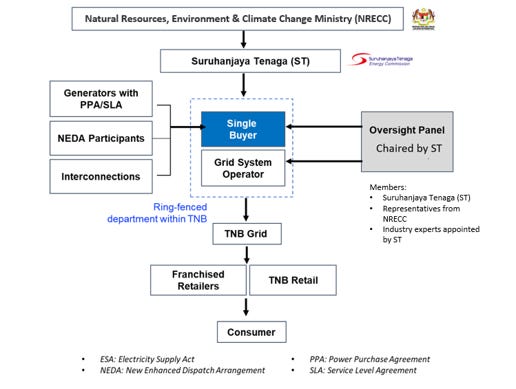
While SB is an entity placed within TNB, it is “ring-fenced”. This means it operates with separate accounts, governance, and decision-making processes to ensure procurement decisions are fair, transparent, and non-discriminatory. So, it is not treated as “just another business unit” that prioritizes TNB’s own generation.
Once power producers are contracted under approved PPAs or SLAs, their generating units (power producing units within a power plant) are connected to the National Grid.
The National Grid (comprised of towers, cables, substations, etc.) is operated by the Grid System Operator (GSO), another ring-fenced entity within TNB. Its primary duties include operational planning, generating unit dispatch, and coordinating all parties connected to the grid in compliance with the Malaysian Grid Code.
In a nutshell, GSO is the “traffic controller” of the electricity system. It has authority to instruct power plants to maintain, increase, or reduce output based on system conditions to prevent outages.
#3: Transmission
Electricity that is generated will be stepped up and transported over long distances via the National Grid. While this grid is operated by GSO, it is physically owned by TNB. They are responsible for managing the full lifecycle of the grid, including new grid construction, upgrades, and maintenance. In return, TNB is compensated for the costs incurred based on the Incentive-Based Regulation (IBR) Framework.
#4: Distribution
This is the last mile delivery of electricity from transmission substations to end-consumers by lowering down the voltage. This distribution grid is also physically owned by TNB. Similar to “Transmission” segment, TNB is compensated for the costs incurred in maintaining & building these grid.
#5: Retail
Retail covers billing and collection as well as “beyond kWh” solutions such as rooftop solar and EV charging.
Revenue is collected as a bundled tariff and then distributed to the other segments (SB, GSO, Transmission and Distribution) based on their approved compensation as per the IBR Framework.
The Rulebook: Incentive-Based Regulations
Notably, TNB is the only company that owns the National Grid and also involves in the power generation segment in Peninsular Malaysia. Other power companies such as Malakoff, Edra Power or YTL Power participate only in the “Generation” segment. This makes TNB a natural monopoly in Malaysia’s power sector.
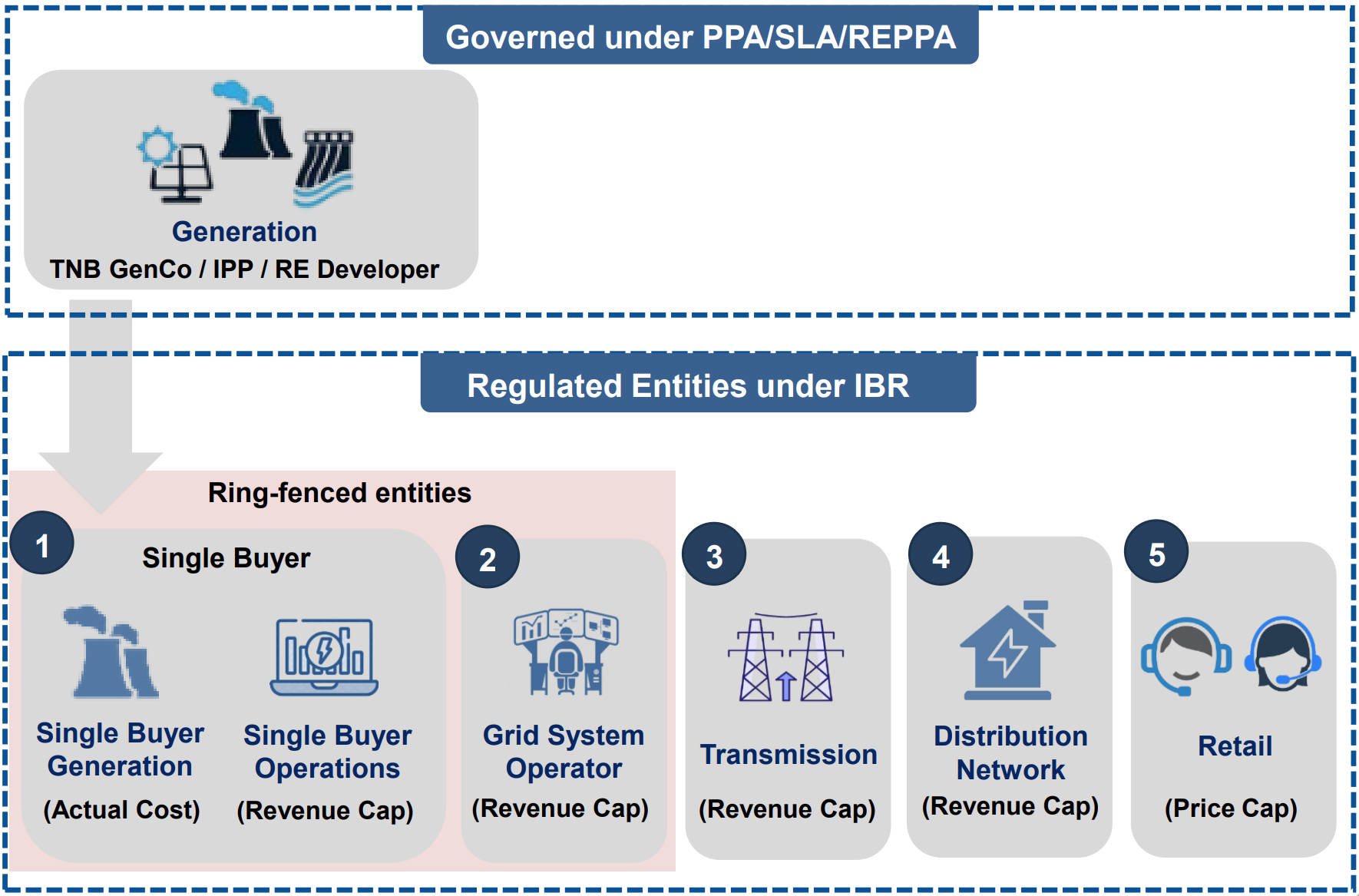
As such, a rulebook is required to govern this sector to ensure efficiency and affordability of electricity. This rule book is known as Incentive-Based Regulations (IBR) Framework.
Based on this IBR framework, TNB’s involvement in below segments of the electricity supply chain are classified as Regulated Business Entities (RBEs):
Procurement & Grid Management (Technically, not part of TNB)
Transmission
Distribution
Retail
This means TNB’s revenues, capital investments, and operating costs incurred within the above 4 segments are tightly regulated by this framework.
Think of this IBR framework as a government contract with TNB that dictates how much electricity tariff should be charged and what profit rates are allowed for TNB. Also, this contract is adjusted every 3 years – known as “Regulatory Period (RP)”. Malaysia is currently in RP4, which runs from 2025 to 2027.
At its core, TNB is not paid based on how much electricity consumer uses. It is paid based on how much it costs to run and invest in the power grid efficiently. The EC calculates the “Annual Revenue Requirement (ARR)”, which essentially reflects how much money TNB needs to run and maintain the power grid, plus a fair profit. Electricity tariff is then structured to recover this amount.
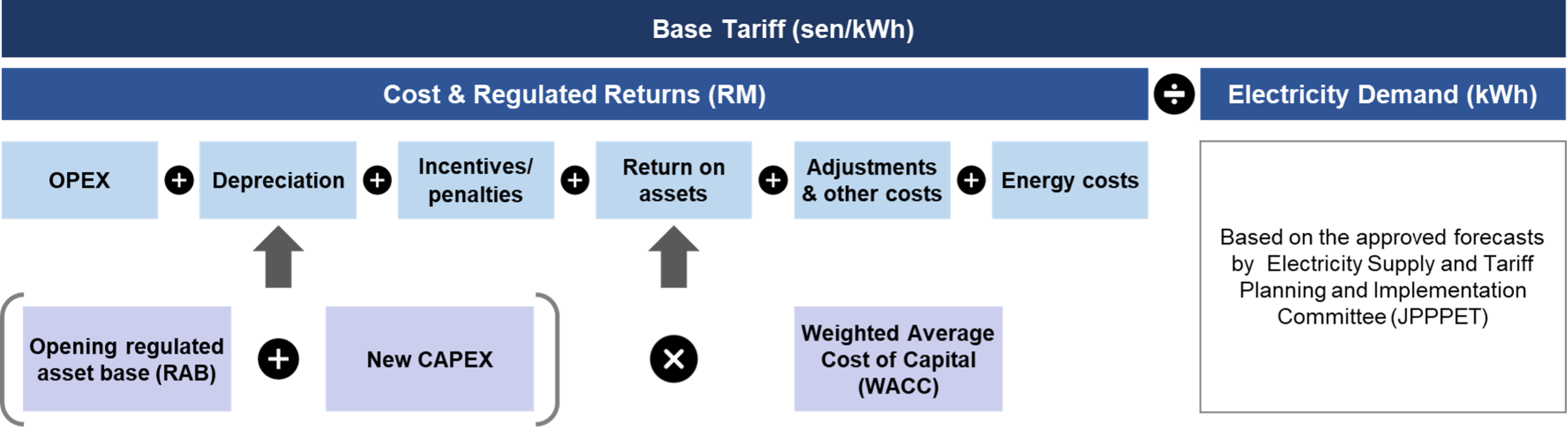
EC uses this “Building Block” formula to figure out the ARR, which comprised of:
The problem comes when there’s fluctuations in below two areas:
Prices of energy sources such as coal, natural gas and fuel
Electricity consumption
Because these 2 fluctuations will affect TNB’s profitability. Higher energy costs will lead to TNB paying more for the power generation than amount collected from consumers based on the base tariff rate and vice-versa.
Similarly, lower electricity demand would mean lower revenue collection from consumers and vice-versa. This will cause shortfall or surplus in the ARR.
The IBR framework resolves this by enforcing 2 mechanisms to resolve the shortfall or surpluses:
#1: Automatic fuel adjustment (AFA)
AFA was introduced in July 2025 as part of the RP4. Under this new mechanism, fuel costs are tracked and adjusted automatically on a monthly basis. If coal gets expensive, a small surcharge is added on top of the base tariff; if it drops, consumer gets a rebate.
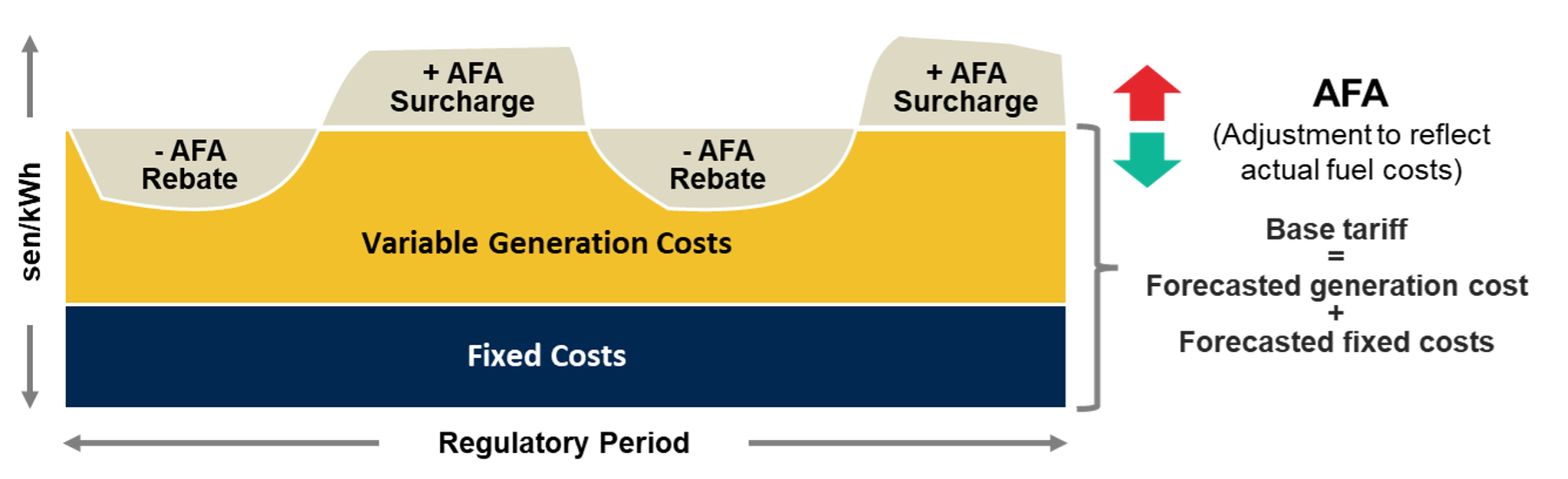
This is different from the past (RP3) where the fuel costs are only adjusted every six months which does not reflect the actual fuel costs efficiently as compared to the AFA.
This new mechanism will improve TNB’s cash flow stability as the company now avoids funding large fuel cost increases out of its own balance sheet.
#2: Revenue-Cap
This mechanism aims to ensure TNB only earns a fixed amount of revenue each year as calculated and approved by EC in advance. If actual electricity sales are higher or lower than expected, tariffs are adjusted in future periods to ensure TNB ultimately receives exactly the approved revenue – no more, no less.
This revenue-cap will make TNB’s core earnings stable, predictable and not volume driven.
Supply Chain Structure in Sabah & Labuan
The supply chain for Sabah and Labuan is managed by Sabah Electricity Sdn. Bhd. (SESB), which is an 83%-owned subsidiary of TNB. This is similar to Peninsular Malaysia where the procurement of electricity is done centrally – Single-Buyer Model as explained above. Both the SB & GSO is a ring-fenced unit within SESB.
Below are the key differences of supply chain in Peninsular Malaysia, Sabah & Labuan:
That said, Sabah state government is currently working on a financial plan to buy back SESB completely by 2030 from TNB. This takeover is intended to give Sabah total control over its supply chain, from generation to billing, allowing it to align the utility’s operations more closely with local industrial needs. As such, not worth looking into it further.
Now that I’ve covered the energy landscape in Malaysia, my next post will take a deeper dive into Tenaga’s business model and the key risks to take note. Stay tuned!