

Investment Thesis
Turnaround play, not a value trap…yet. Heineken Malaysia is down -44% YTD on excise duty risk, softer 2H 2026 volumes, and a declining trend in Malaysian beer consumption.
Singapore is the swing catalyst. Shifting Singapore production to Malaysia could offset ~20% of local volume losses, backed by Singapore’s beer market growing at a 2.8% CAGR through 2028.
Reverse valuation flags mispricing. At RM14.18, the market is pricing in a ~48% earnings collapse, worse than the pandemic lows.
⚠️Disclaimer: Word of Caution!
Please DO NOT take this educational post as a buy or sell signal. When it comes to investing, it is important to have your own judgement. Despite my detailed analysis, mistakes may occur, and blindly following could lead you to make similar errors and financial losses. Furthermore, I AM NOT a licensed financial advisor. I’m merely sharing my experiences and opinions only.
Additionally, please note that I hold positions in the discussed stock, and my view may be biased as a result.
Heineken Malaysia Berhad (“Heineken Malaysia”) is a major producer of beer, stout, cider and non-alcoholic malt beverages in Malaysia and has been listed on the Main Board of Bursa Malaysia since 1965.
It has been one of my most painful position on Bursa Malaysia this year. Year-to-date (YTD), the stock has dropped -44% from its high of RM25.30 to RM14.18 at the time of writing.
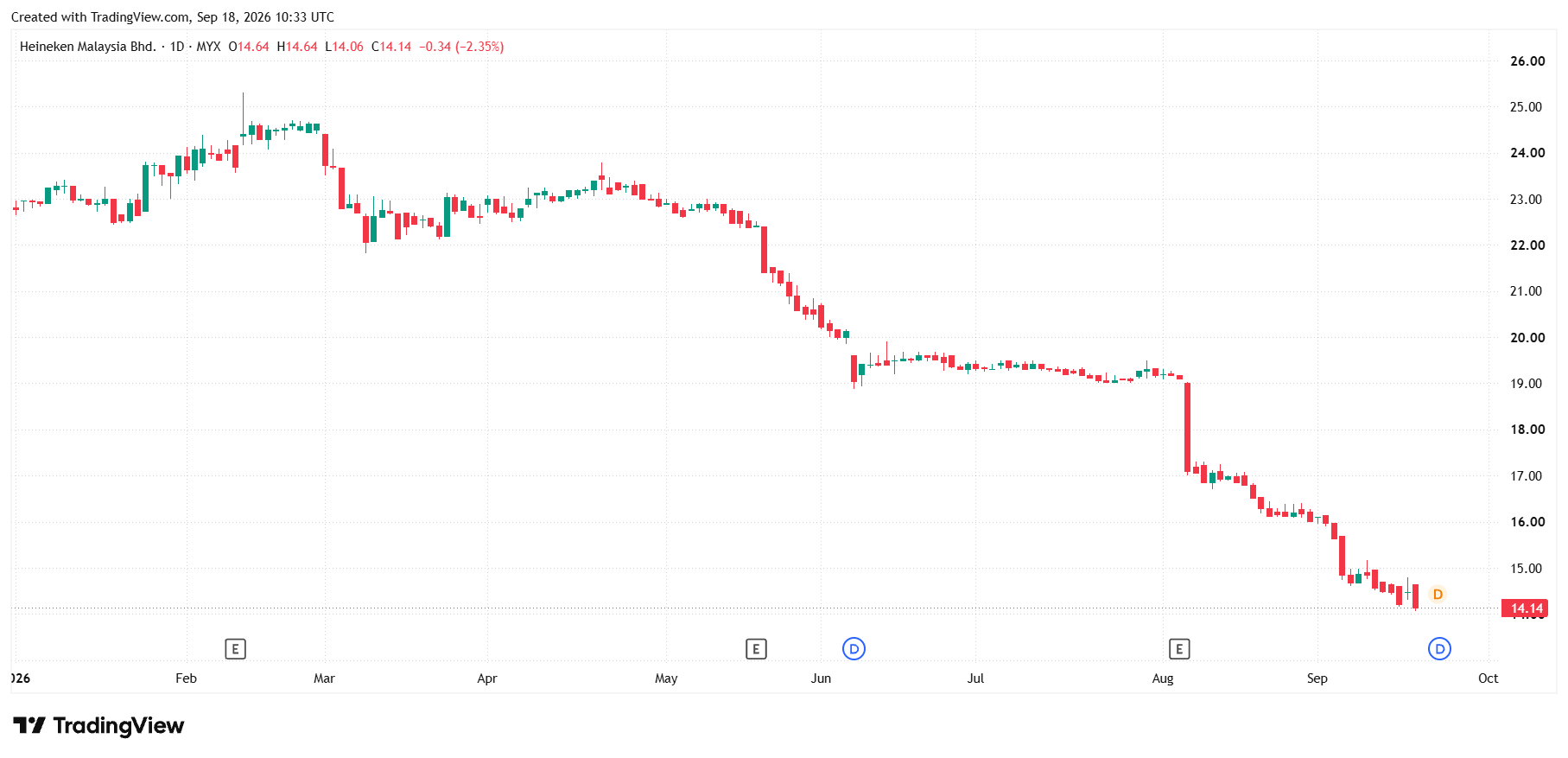
As someone who’s been holding this name, I wanted to walk through what’s actually driving the sell-off, whether I think it’s temporary or permanent, and what the current price is really implying about Heineken Malaysia’s future.
Why Did Heineken Malaysia Plunge?
A -44% drawdown doesn't happen without real fundamental concerns behind it. There are three overlapping reasons the market has been punishing Heineken Malaysia this year:
#1: Potential excise duty hike in Budget 2027
In November 2025, we already saw an excise duty hike on beer. Analysts are now expecting another hike to be tabled in Budget 2027 and the market hates uncertainty on this front, since every duty hike squeezes margins and dampens consumption.
#2: Management are guiding volume softness in 2H2026
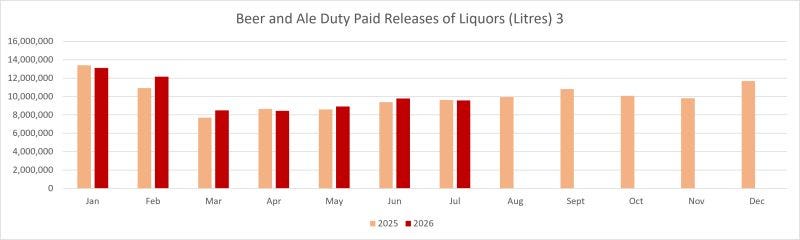
In 1H 2026, beer volume in Malaysia decreased. The main culprit is inflation — higher input costs and weaker consumer sentiment mean more people are choosing to spend less. Even the Visit Malaysia 2026 campaign and the World Cup 2026 hasn’t been enough to lift beer consumption volume in 1H 2026.
The resolution to this is “inventory normalization”. Heineken Malaysia has to produce and sell less to distributors, since distributors are still sitting on inventory. Until that inventory drops to an acceptable level, sales could stay slower for Heineken Malaysia.
With consumer sentiment still poor, the US Fed’s recent interest rate moves strengthening the USD (and therefore raising input costs), and the potential excise duty hike in Budget 2027 looming, management has guided that 2H 2026 will be a tougher operating environment.
#3: Overall beer volume in Malaysia is in declining trend
This is one to watch closely, since the bulk of Heineken Malaysia’s sales is still local. This isn’t unique to Heineken Malaysia either. Carlsberg Group’s Malaysia and Singapore beer volumes — measured in hectolitres (hl), the standard unit brewers used to report volume, where 1 hl = 100 litres — have declined three years straight: 1.5 million hl in FY2023, down to 1.33 million in FY2024, and 1.31 million in FY2025. That points to a broader structural pullback in regional beer consumption, not just a company-specific issue.
One thing worth noting, younger generations are drinking slightly less beer compared to older generations. This could become a worrying sign if consumption by younger generations drops significantly but… this isn’t happening yet.
Is This a Temporary or Permanent Issue?
In my opinion, I think it is a temporary issue with potential to become permanent if the consumption from younger generations continues to deteriorate.
As such, I don’t think this is an investment I can hold for the long-term anymore, because it carries a risk that could grow big and become a permanent value trap similar to what I’ve seen with tobacco stocks. Heineken Malaysia has effectively become a turnaround play.
That said, I’m still holding my position, and possibly looking to add more. There’s one catalyst left that I want to see it play out, and that’s new revenue from Singapore.
Export Revenue From Singapore
The closure of the Singapore brewery and the shift of that production over to Heineken Malaysia could offset roughly 20% of the beer volume losses in Malaysia.
Singapore’s beer volume is forecasted to grow at a CAGR of 2.8% from 2023 to 2028.
Industry commentary from Singapore Beverage Brief also suggests beer volume in Singapore is recovering gradually.
Valuation: What is the Market Pricing In?
Because Heineken Malaysia has become a turnaround play, simply using the 5-year or 10-year average historical dividend yield (DY) or PE ratio to value the company may be unrealistic.
I recently learned about the “reverse valuation” method, and I think it’s particularly suited to turnaround companies like this one.
A reverse valuation takes the current stock price as a hard, undeniable fact. Then, it works the financial math backward to figure out exactly what kind of future is already “priced in” by the market.
Heineken Malaysia’s Implied DPS and EPS
Current share price (18/9/2026) = RM14.18
To justify the current price of RM14.18, assuming the price eventually returns to both its 5-year median DY and PE, the underlying fundamentals would need to be:
Implied DPS: RM14.18 × 5.6% (median DY) = RM0.794 per share
Implied EPS: RM14.18/18 (median PE) = RM0.79 per share
The market is anticipating a roughly ~48% permanent collapse in Heineken Malaysia’s fundamentals to justify trading at RM14.18.
Why? In FY2025, Heineken Malaysia generated EPS of RM1.52 and pays out 100% as dividend. If both the implied DPS and EPS becomes reality for FY2026, then the market is anticipating a reduction of -48%.
Below is the company’s historical DY and PE chart:
Conclusion: Heineken Malaysia is Undervalued
For context, an EPS of RM0.79 would place their earnings roughly in line with the depths of the 2020 – 2021 pandemic lockdowns (RM0.51 to RM0.81, respectively) — a period when breweries and bars were literally mandated to shut down.
I think the current sell-off is overdone. Here’s why:
YTD, the EPS stands at RM0.513, meaning Heineken Malaysia needs to grow EPS by 35% over the next two quarters to hit the implied RM0.79.
This is achievable because even in FY2020’s Q3 and Q4, at the depths of pandemic-level earnings, Heineken Malaysia still posted quarterly EPS of RM0.20 and RM0.18.
Layering this onto the current RM0.513 brings the full-year total to RM0.89.
Multiplying RM0.89 by the 5-year median PE of 18 gives an intrinsic value of RM16.02 which is about 13% above the current share price and this is the worst-case scenario.
Assuming a 100% payout ratio, the expected DPS would also be RM0.89, putting the DY at 6.3%. It is still an attractive yield even in this worst-case scenario.
With the Singapore export revenue as the catalyst, I think Heineken Malaysia would recover from next year onwards. I will be watching their upcoming results and Budget 2027 closely.
Until my next post! 🙂
⚠️Disclaimer: Word of Caution!
Please DO NOT take this educational post as a buy or sell signal. When it comes to investing, it is important to have your own judgement. Despite my detailed analysis, mistakes may occur, and blindly following could lead you to make similar errors and financial losses. Furthermore, I AM NOT a licensed financial advisor. I’m merely sharing my experiences and opinions only.
Additionally, please note that I hold positions in the discussed stock, and my view may be biased as a result.